AI4Science
Bayesian MCMC for Ebola Outbreak Data
Solo project, University of Michigan, BIOSTAT 682: Applied Bayesian Inference
How fast are infectious people removed from circulation during an Ebola outbreak — and does that speed change as the outbreak grows? Working from individual-level records of one outbreak wave (about 1,000 cases), I built a sequence of Bayesian models for BIOSTAT 682.
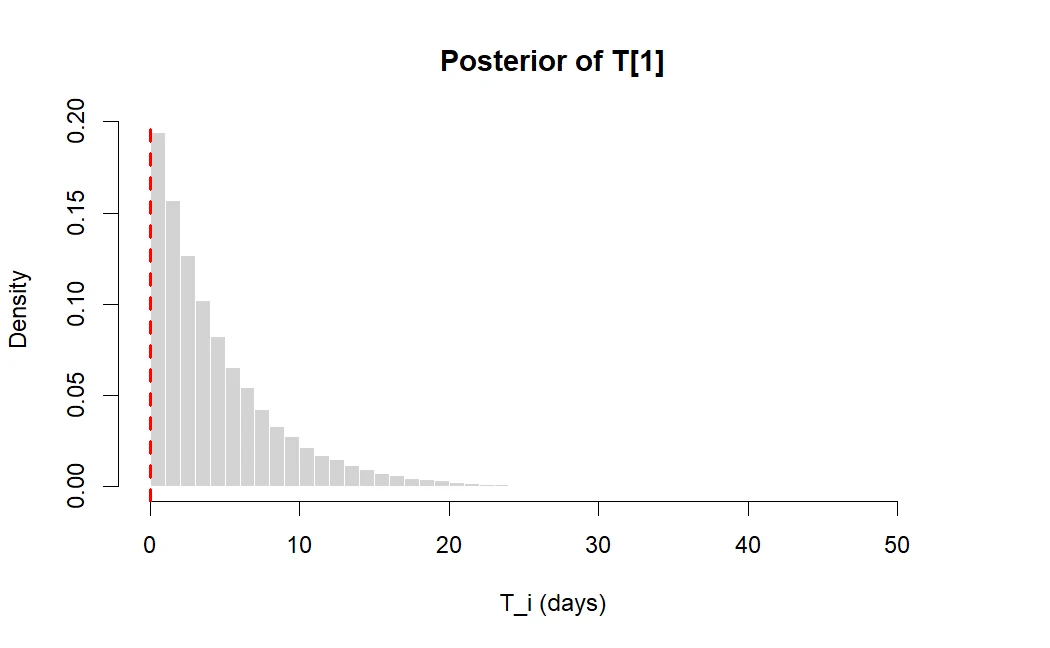
Censoring, handled honestly. Symptom onset is observed, but many removal times are only known to be later than some date. An exponential survival model with Bayesian data augmentation treats those latent times as parameters and samples them jointly with the removal rate by MCMC. The posterior removal rate is about 0.22 per day (95% CI 0.20–0.23), a mean infectious period of roughly 4.6 days, with R̂ ≈ 1 and effective sample sizes above 50,000.
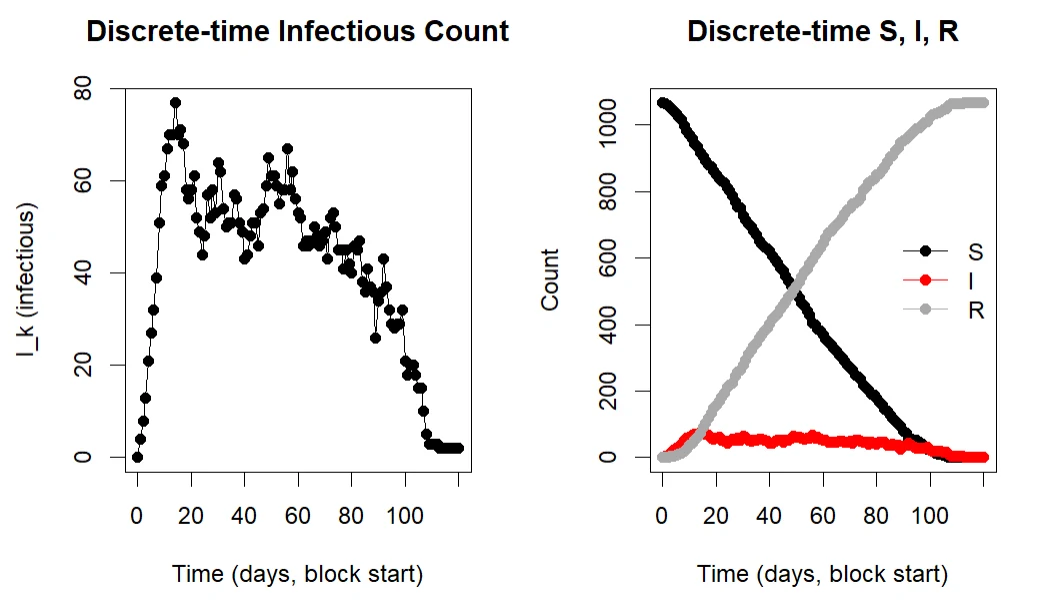
From people to the epidemic curve. Each posterior draw of the latent times rebuilds a daily susceptible–infected–removed trajectory, so the uncertainty about individual removals carries through to credible bands around the whole epidemic curve — a more honest picture than a single deterministic SIR fit.
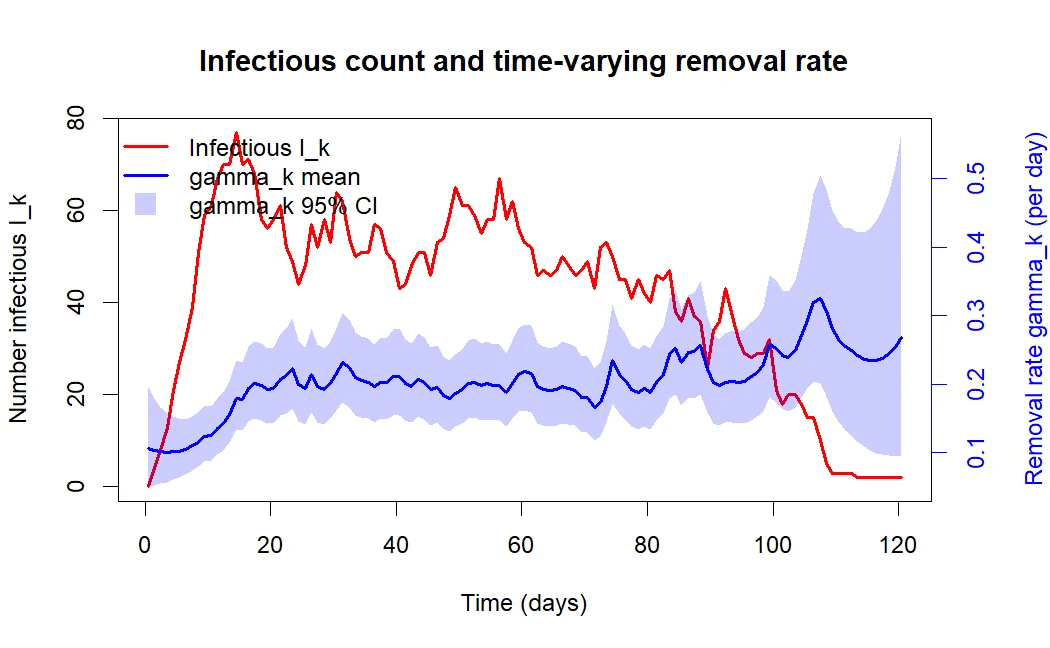
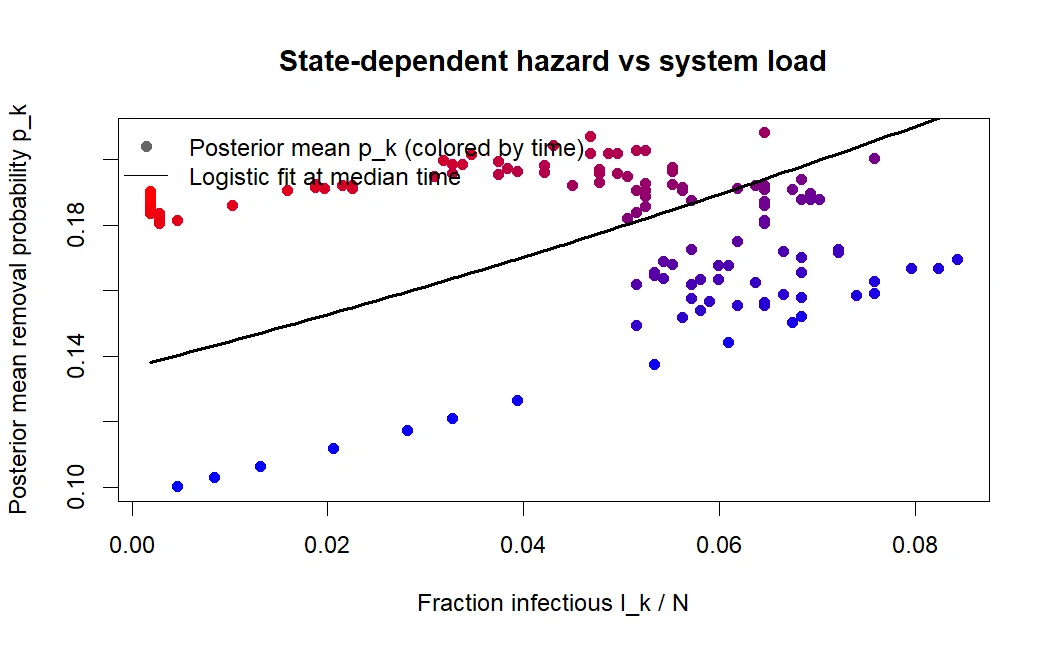
A response that sped up. Aggregating to daily blocks, a random-walk prior lets the removal rate drift over time, and a Bayesian logistic regression links it to system load. The coefficient on the infectious fraction is strongly positive (6.48, 95% CI 1.61–11.45): removal got faster as cases rose, consistent with isolation efforts scaling up. A positive time trend (0.22) suggests outbreak management also improved with experience.
What it involved
- Work
- Bayesian modellingMCMC samplingEpidemic reconstructionTime-series modelling
- Knowledge and tools
- Survival models with censoringData augmentationMetropolis–Hastings MCMCDiscrete-time SIRRandom-walk priorsBayesian logistic regressionConvergence diagnosticsR and Stan
Figures