Human–AI interaction
MagicBaton
Project lead, University of Michigan, EECS 498: Machine Learning for Computational Sensors in Mobile/IoT Systems, PAT 564
A conducting baton that turns gestures into live musical control. A team project with Yi Rong, Tiffany Cheung, Xiaolan Zhou and Aryan Thomare for EECS 498 (Machine Learning for Computational Sensors in Mobile/IoT Systems), later extended into a generative-music instrument for PAT 564.
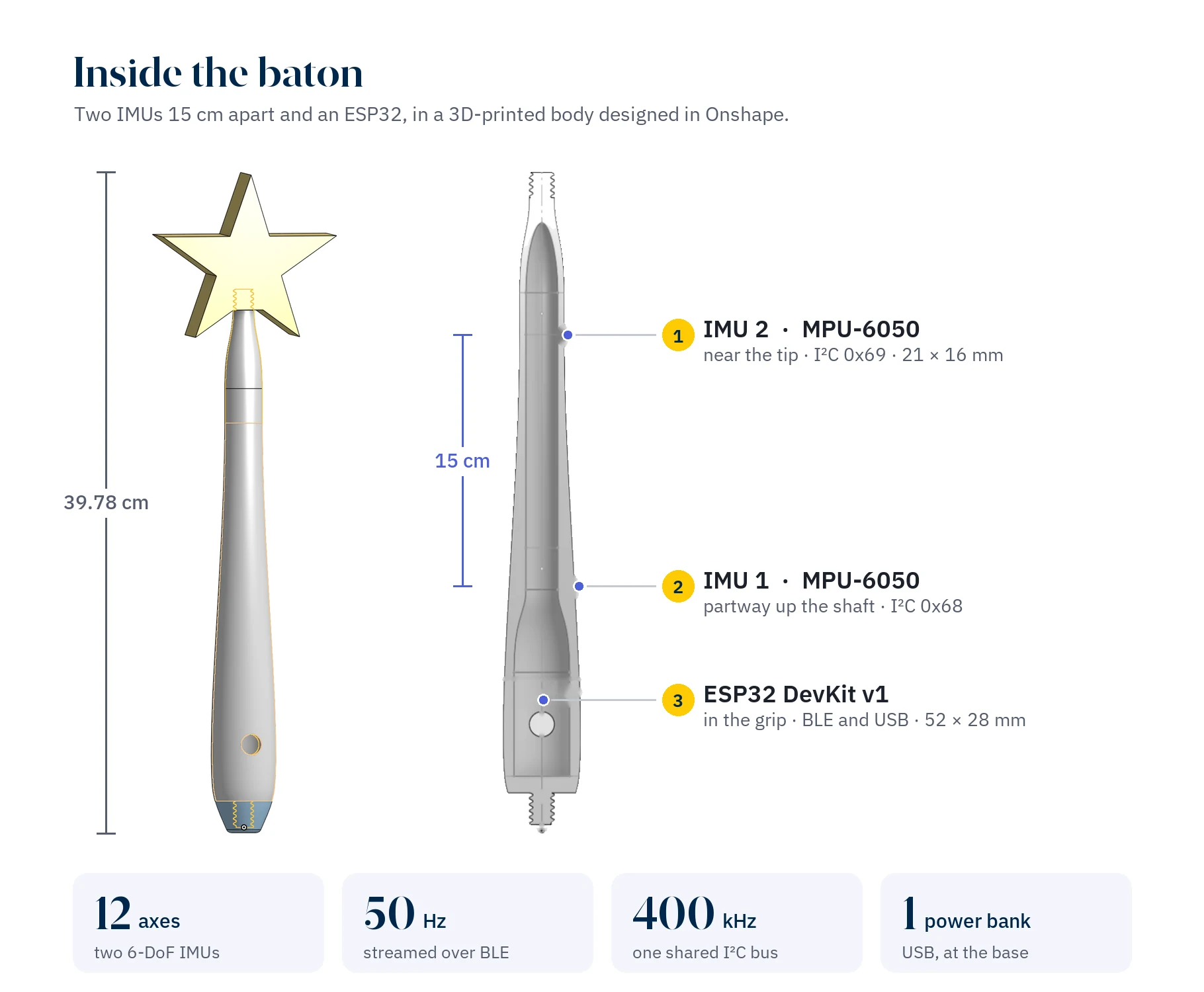
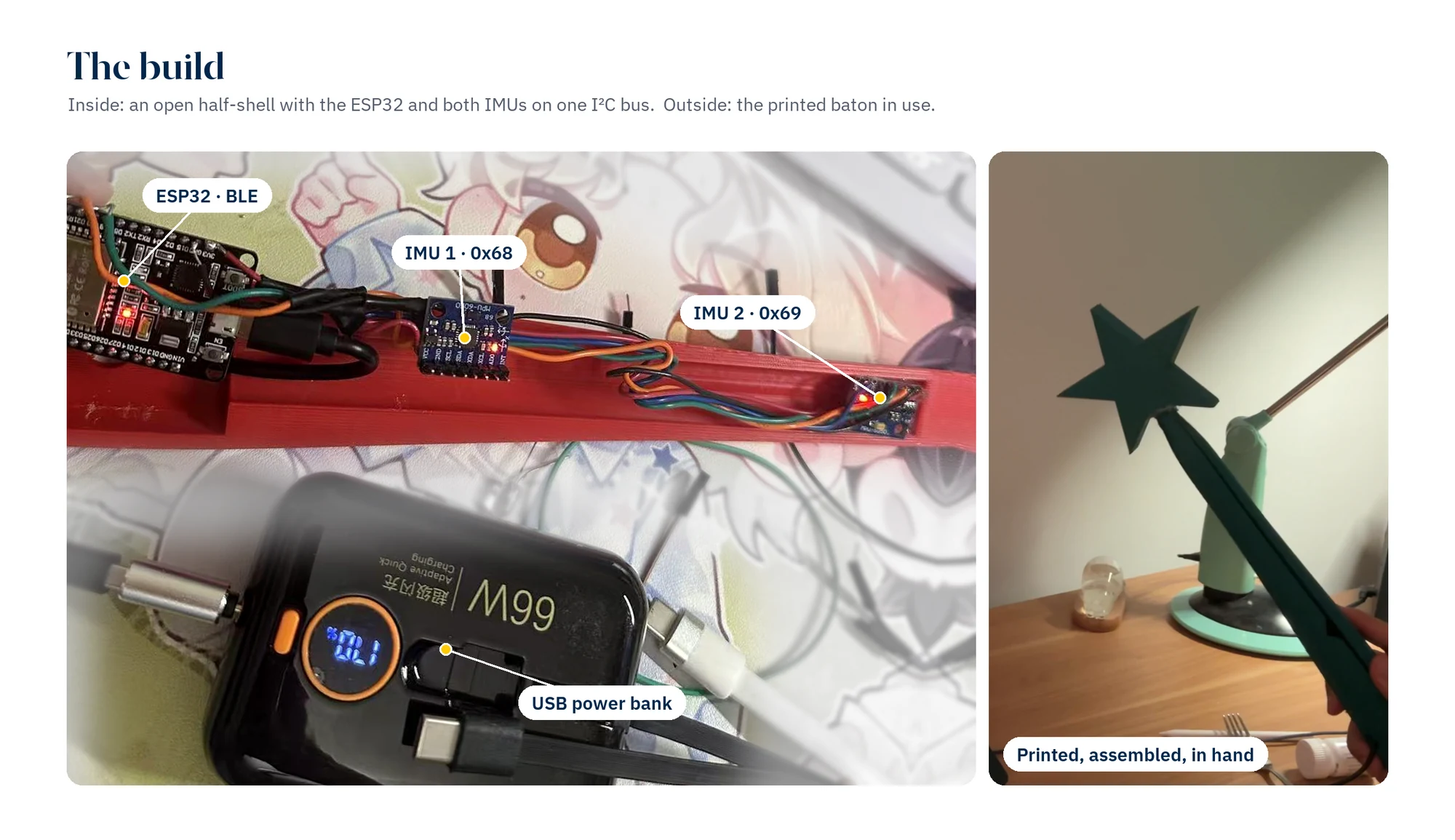
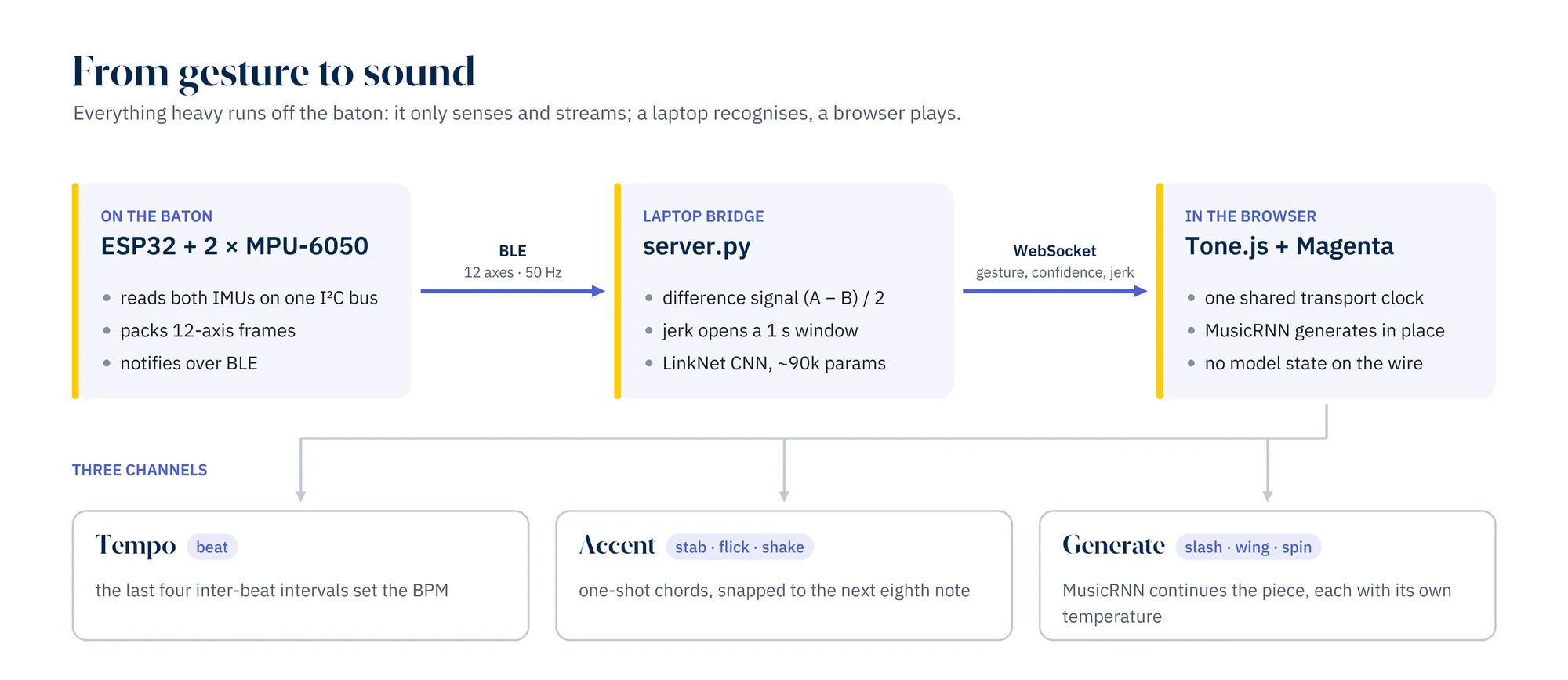
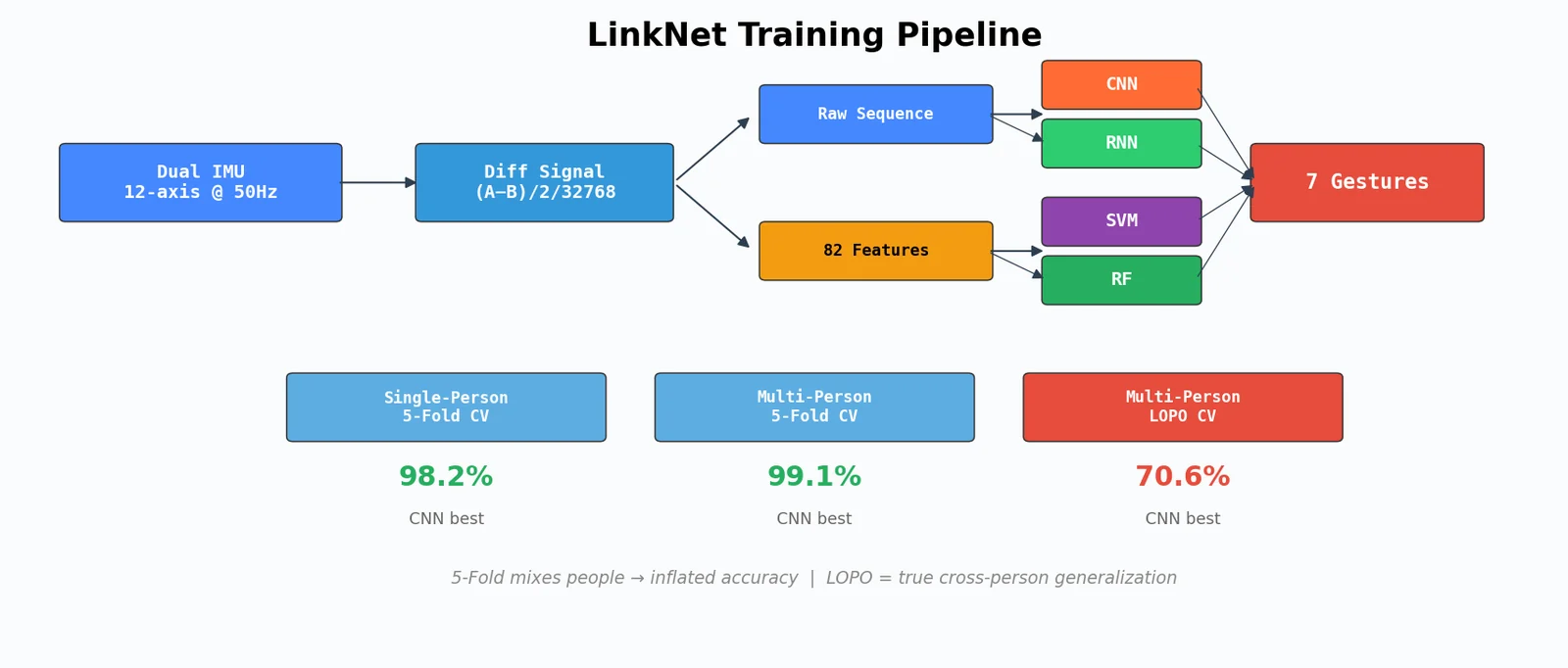
The hardware. The baton is a 39.78 cm body designed in Onshape and 3D-printed over several iterations, in sections that screw or snap together so the electronics stay reachable (Figure 1). The grip widens to about 3.8 cm to hold an ESP32 DevKit v1; one MPU-6050 sits partway up the shaft and a second near the tip, 15 cm apart. Both share a single 400 kHz I²C bus — tying one AD0 pin to ground and the other to VCC gives them the addresses 0x68 and 0x69 (Figure 2). The ESP32 reads all 12 axes at 50 Hz and streams them over BLE as the device “MagicBaton”, with USB serial as a fallback; a USB power bank rides at the base. Everything heavier happens off the baton (Figure 4).
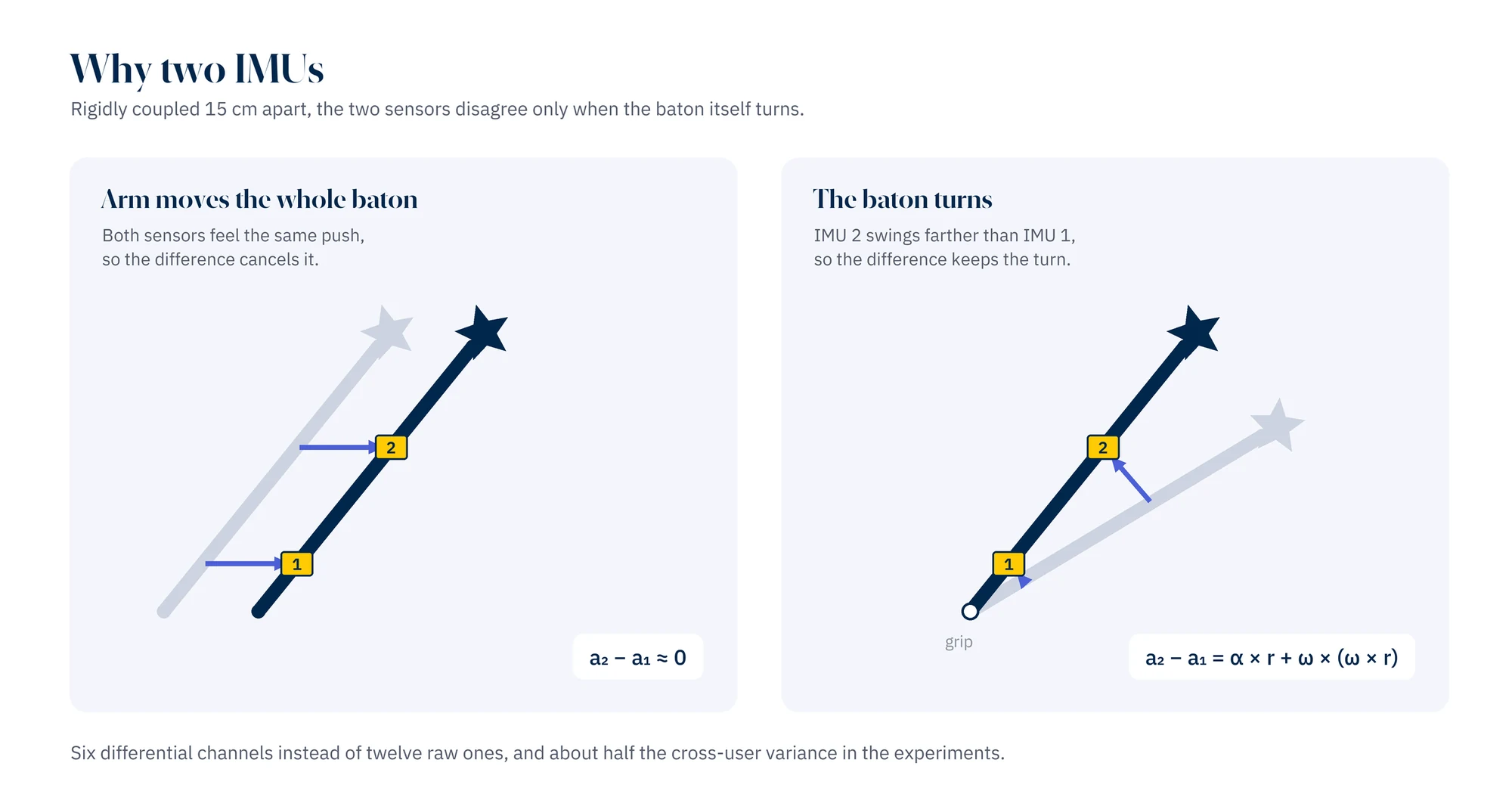
Why two IMUs. Because the two sensors are rigidly coupled, moving the arm pushes both the same way and their half-difference (A − B) / 2 cancels it, while turning the baton swings the far sensor more, so the difference keeps exactly the rotation a conductor’s gesture is made of (Figure 3). Six differential channels replace twelve raw ones, with roughly half the cross-user variance.
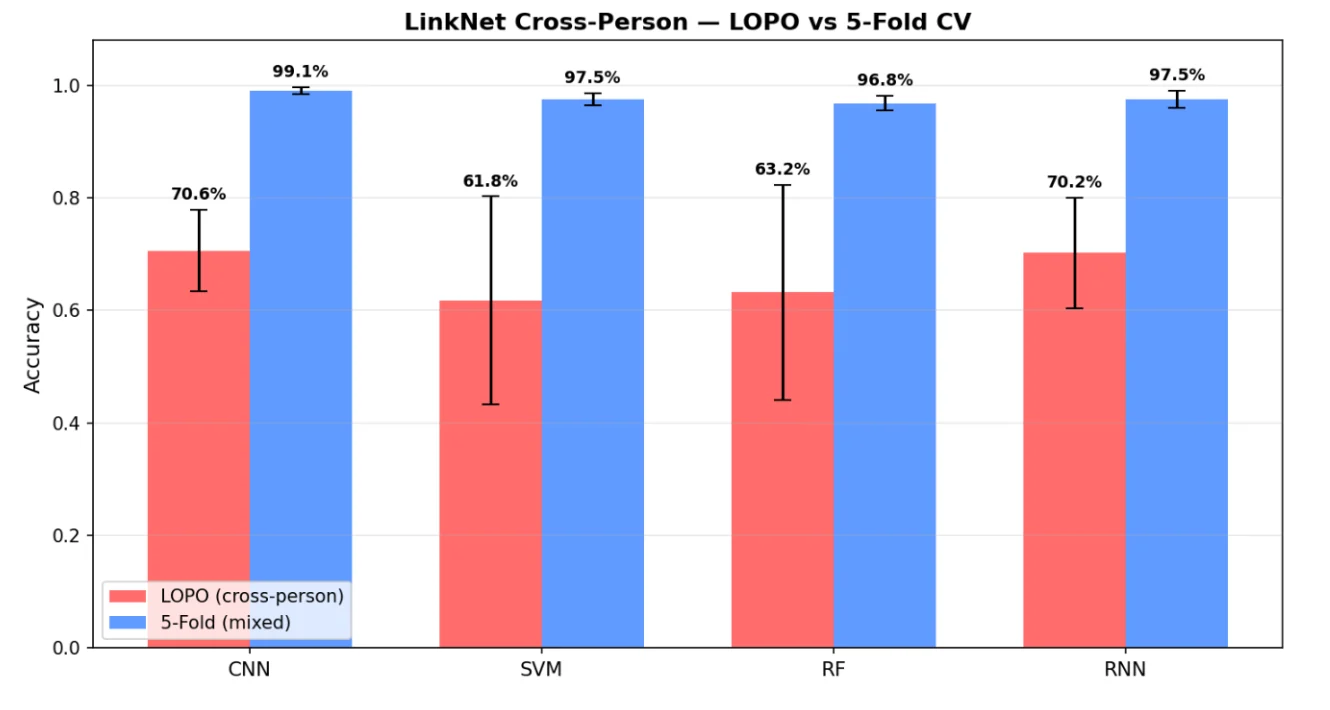
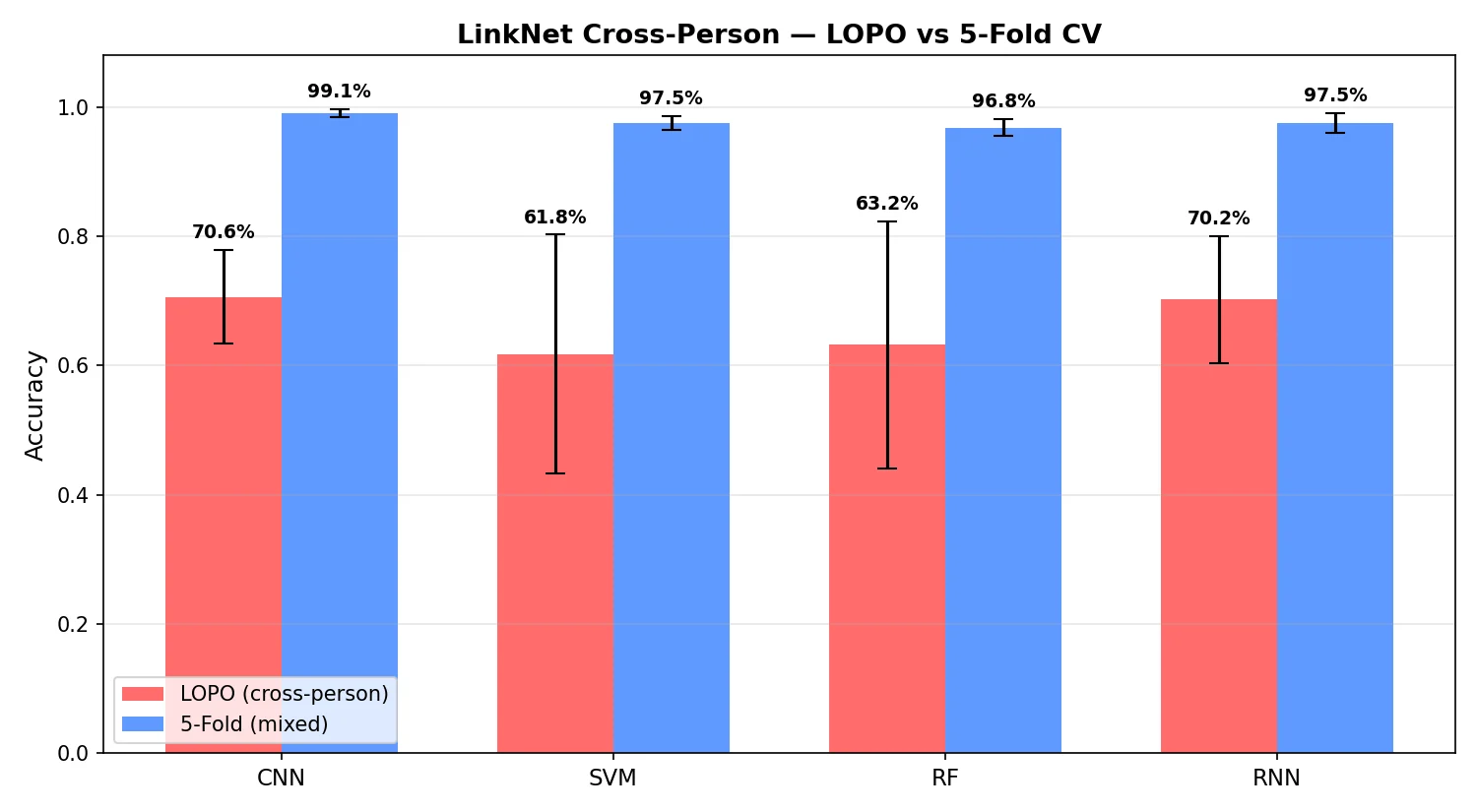
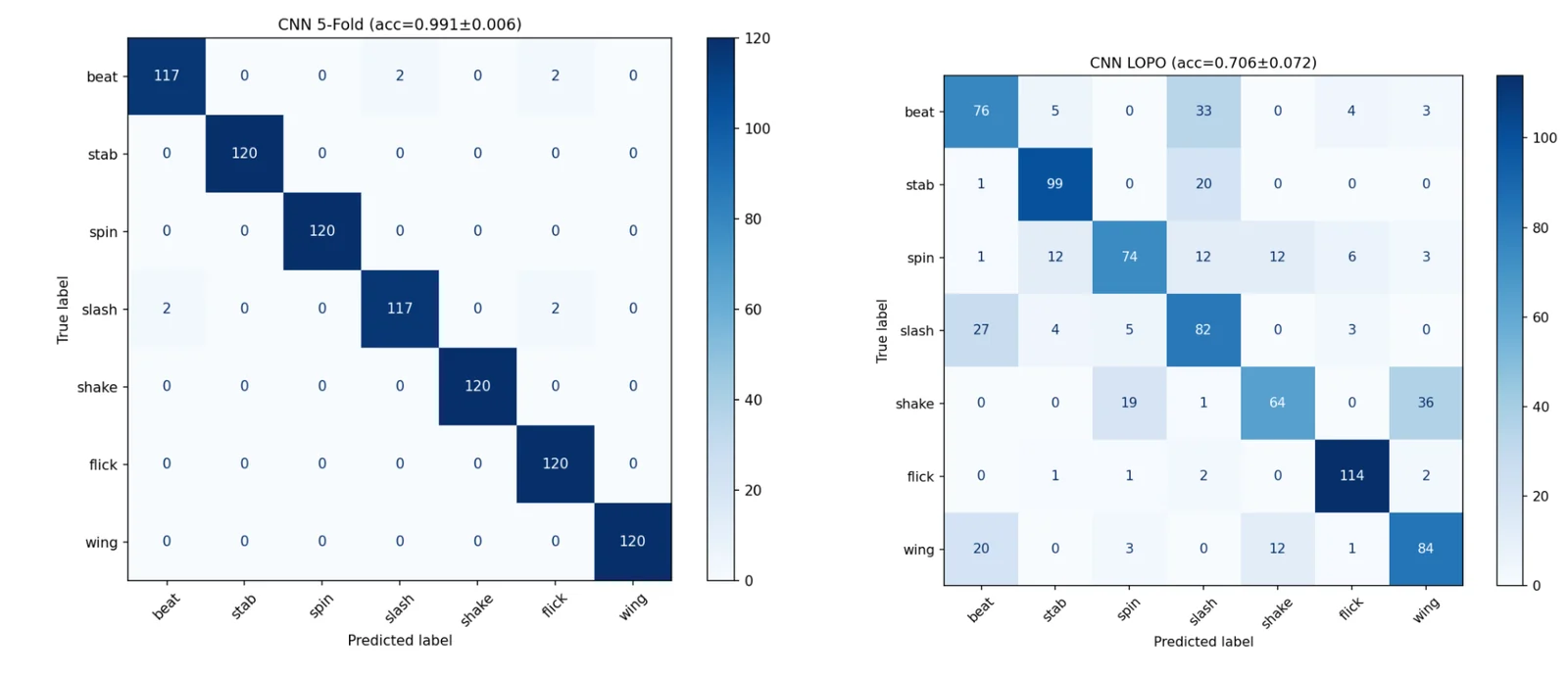
Recognition. We recorded 934 clips from four people across eight classes (beat, stab, spin, slash, shake, flick, wing, idle) and released them as a public dataset. A 38k-parameter 1-D CNN reaches 98–99% when users are mixed, but 70.6% on a person it has never seen; an SVM and a random forest match it within users but drop to about 60% on new people, with far wider spread. The gap between people, not model capacity, is the real problem.
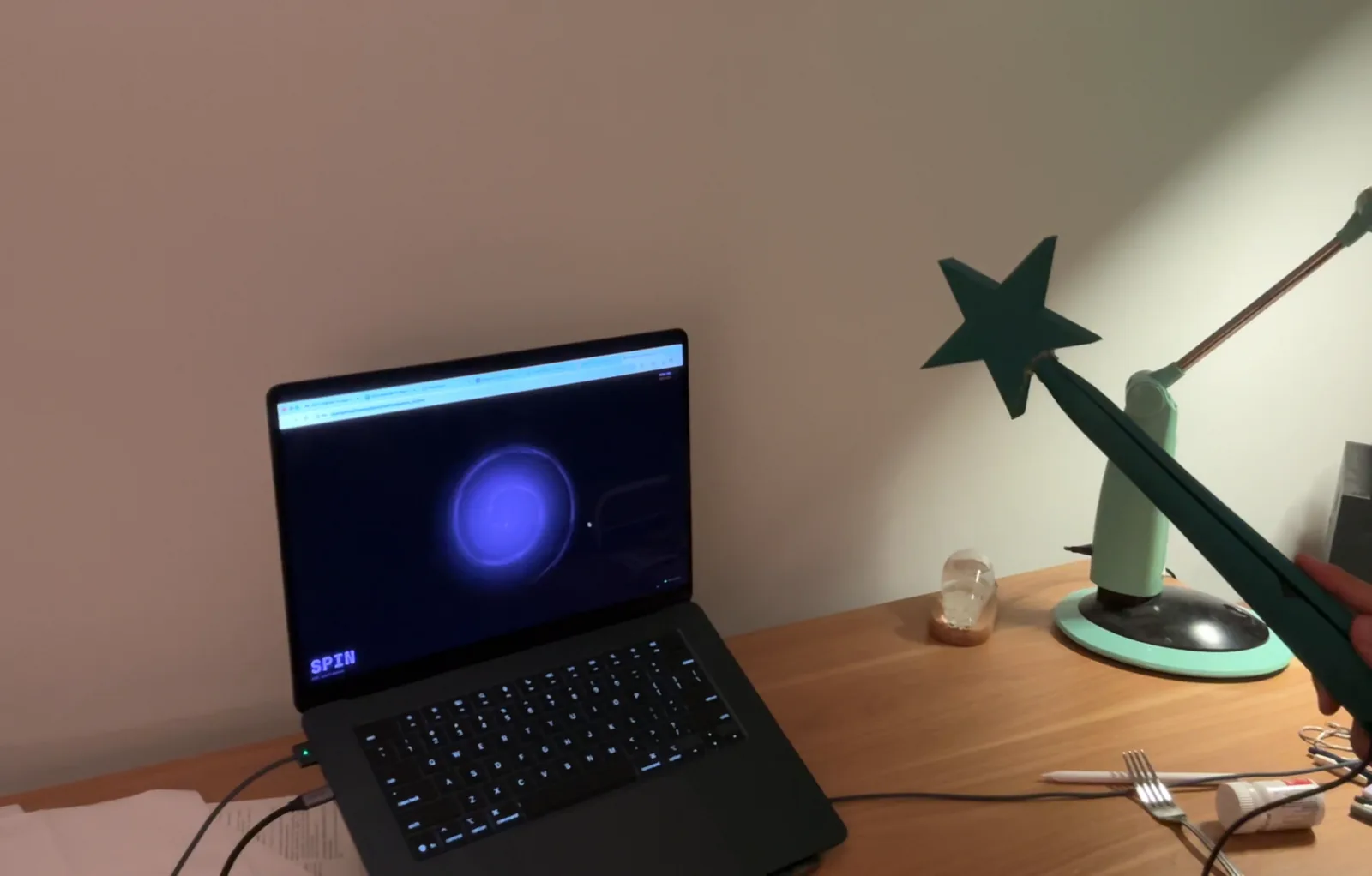
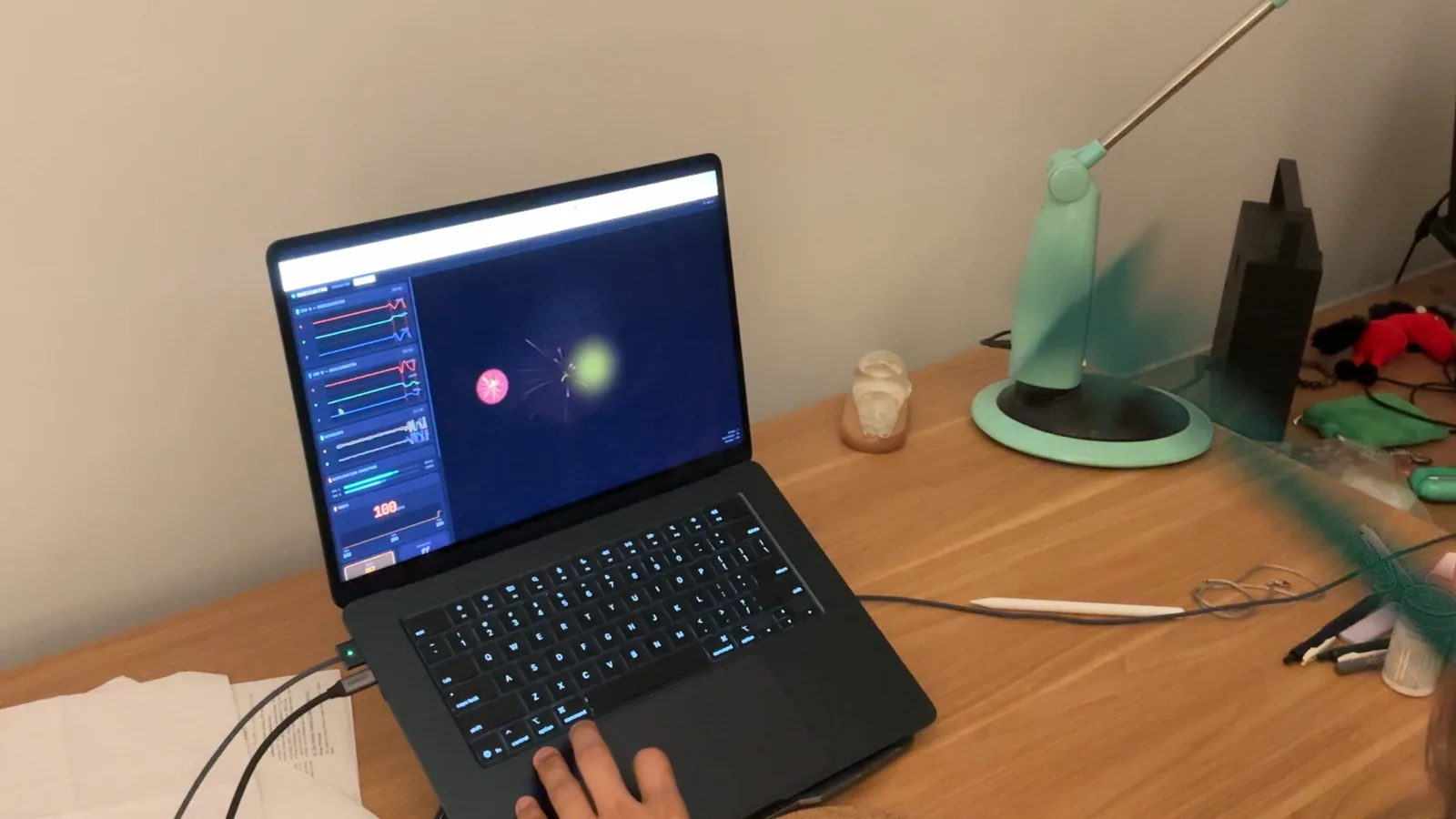
Three ways to play. In the browser, Tone.js and Magenta’s MusicRNN listen on three channels. Beats set the tempo from the last four inter-beat intervals; stab, flick and shake fire accents quantised to the next eighth note; slash, wing and spin ask MusicRNN to continue the music with different seeds and temperatures. The conductor can pace, ornament and recompose at once.
Next. More people and a short per-user calibration to close the cross-user gap. On the hardware side, the external wiring and power bank still make the prototype bulkier than a real baton; a self-contained enclosure with a small battery and the model quantised onto the ESP32 would make it a standalone instrument. Beyond that, the baton is to become the conductor’s instrument for SuperConductor, steering a real-time music model and deciding when it follows and when it improvises.
What it involved
- Work
- Hardware prototypingEmbedded firmwareDataset collectionModel training and evaluationReal-time interactionGenerative music
- Knowledge and tools
- ESP32I²C and BLEMPU-6050 IMUsRigid-body kinematicsOnshape CAD3D printingPyTorch1-D CNN and BiGRUSVM and random forestLeave-one-person-out CVJerk-based onset detectionWebSocketTone.jsMagenta MusicRNN
Videos
Figures